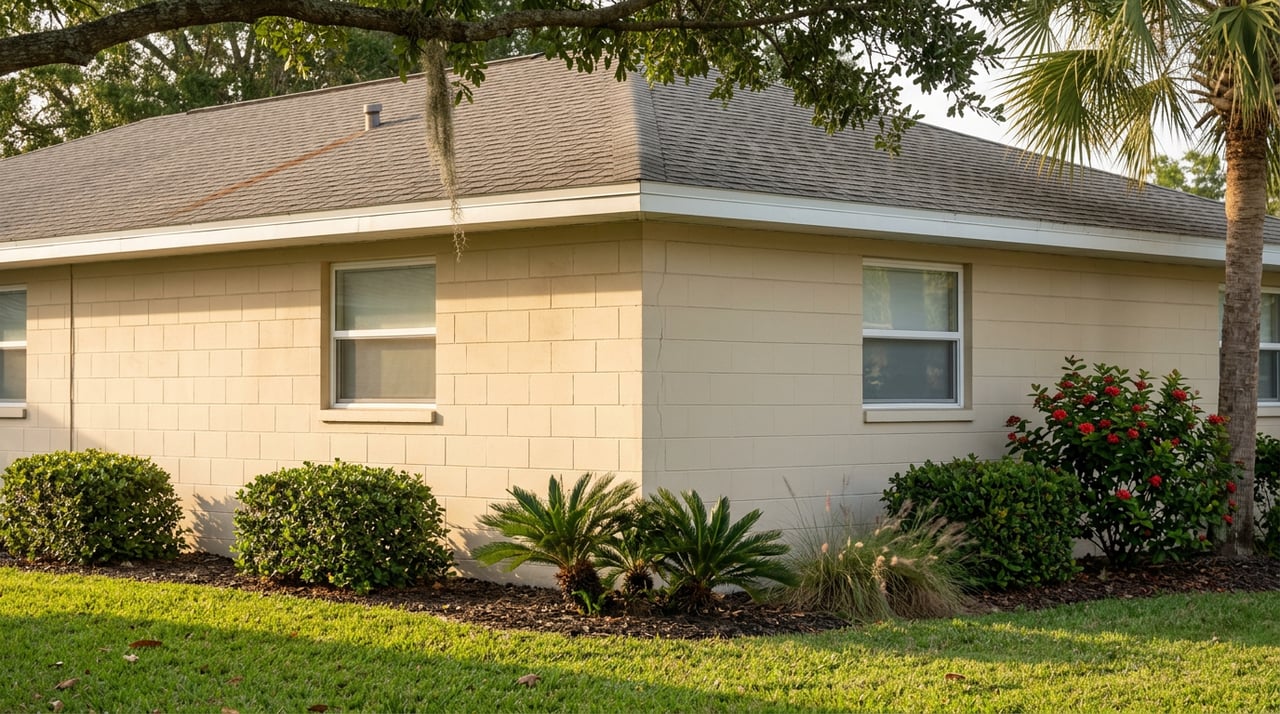
In February 2026, Marion County Utilities issued a precautionary boil water notice for residents along Spring Road and Spring Loop in Silver Springs Shores. Crews were mid-project, tying new water lines into the main so they could keep moving forward on a septic-to-sewer conversion that has been years in the making. Six months later, the trucks are still out there, working street by street through a community that has spent five decades selling itself partly on the fact that it does not have a water or sewer bill.
That framing is about to flip, and it is not flipping evenly. Whether a specific address in Silver Springs Shores is closer to a mandatory sewer hookup or years away from one depends entirely on which phase line it falls inside.
The four lines running through the neighborhood
Marion County's septic-to-sewer program in Silver Springs Shores is not one project. It is four separate phases, each covering a defined area of streets, each at a different stage of funding and construction. Here is where things stand:
| Phase | Area | Lots (occupied septic) | Boundary streets | Status |
|---|---|---|---|---|
| I | 192 acres | 455 lots (212 occupied) | County Road 464 (SE Maricamp Road), Spring Road | Construction underway |
| II | 237 acres | 406 lots (229 occupied) | Pine Run, CR 464, Bahia Road | Contract awarded to Wharton-Smith, Inc. |
| III | 180 acres | 402 lots (252 occupied) | Bahia Road, Hemlock Radial Circle, Hemlock Loop | Subject to final approval and funding |
| IV | ~300 acres | 596 lots (341 occupied) | Bahia Road, Maple Run, Hemlock Road, Bahia Pass | In design as of April 2025, no construction date set |
A smaller companion project, the Unit 16 water and sewer extension near Bahia Road, Spring Road, and Emerald Road, has already been built and closed out. That is the version of this story with a finished timeline. Phases III and IV are the version without one.
Why the county is doing this at all
This is not a beautification project. It traces back to the Florida Springs and Aquifer Protection Act, which requires a remediation plan wherever septic systems account for more than 20 percent of the nutrient load reaching a spring system. Marion County's own review found that both the Silver Springs and Rainbow Springs basins meet or exceed that threshold, which triggered a state-backed obligation to act.
The county has framed the work as protective infrastructure. As Marion County Utilities put it in the February 2026 release announcing the Spring Road work, the project is about "reinforcing its commitment to modern infrastructure, environmental stewardship, and reliable utility service." The county anticipates investing roughly $30,000 per household to complete each conversion, funded in Phase I through federal American Rescue Plan dollars, with homeowners picking up a monthly service charge once they are connected.
How project phases affect home costs
Look at how homes in Silver Springs Shores get marketed today and a pattern shows up quickly: private well and septic setups get framed as a savings line, no water bill, no sewer bill, sometimes no HOA either. For a buyer comparing monthly carrying costs, that reads as an advantage.
The savings calculation changes when a parcel is in a designated program area: Marion County Utilities says connection to the county system is not optional there. The septic tank gets abandoned, the monthly service charge begins, and the county estimates the conversion cost at about $30,000, with grant funding available for connection costs within the allotted time. A feature buyers were told to value under the old framing becomes an obligation under the new one, on a timeline the homeowner does not control.
That is the mechanism a seller in Phase I is dealing with differently than a seller in Phase III. One has a funded, in-progress project with a visible finish line. The other has a designated project area with no construction date and, as the county's own language notes, funding still to be finalized.
The second clock running on the same houses
Silver Springs Shores built up in waves from the 1970s through the early 2000s, mostly ranch homes and bungalows in the 1,000 to 1,500 square foot range, with a handful of larger four-bedroom homes further out. That construction era matters for a second, unrelated reason that happens to land on the same houses at the same time.
Florida's roof age rules tightened again heading into 2026. Separately, Protech Roofing describes the state's 25 percent replacement rule and says the exception applies to roofs built or replaced under the 2007 Florida Building Code, effective March 1, 2009, or later. Anything older still falls under the stricter version of that rule.
A meaningful share of the Shores' housing stock predates that 2009 cutoff. For those homes, a roof repair that looks routine on paper, storm damage on a quarter of the shingles, an aging tile section, can trigger a full-roof code upgrade rather than a patch
What this actually means at the closing table
None of this is abstract once a contract is signed. It shows up in specific ways:
- A buyer's lender may ask directly whether the property sits in a designated septic-to-sewer program area, and whether a connection notice has been issued, before clearing to close.
- If a mandatory hookup notice already exists for a parcel, that is a fact a buyer will find during due diligence regardless of whether it appears on the disclosure form, so sellers are better served putting it there themselves.
- Pricing conversations should account for whether a specific phase's $30,000 conversion is currently grant funded or still an open question, since that changes who is effectively paying for it and when.
None of this applies uniformly across the neighborhood. Silver Springs Shores also includes newer construction and gated golf course sections built on sewer already, where this entire conversation does not apply. The phase map is the thing to check, not a blanket assumption about the whole area.
A short FAQ
Do I have to disclose that my street is in a septic-to-sewer program area? The Florida Second District Court of Appeal has held that Florida sellers are generally expected to disclose known material facts about a property. A pending or mandatory sewer connection with a defined cost and timeline is the kind of fact a reasonable buyer would want before signing, and it will surface during their own due diligence either way.
Does the $30,000 conversion cost come out of my pocket? For homes connecting within the funded program window, the estimate is that grant dollars, including the American Rescue Plan funding covering Phase I, cover the construction, capacity fees, and on-lot plumbing work. The ongoing monthly service charge after connection is the homeowner's responsibility going forward.
Is every home in Silver Springs Shores on septic right now? No. The four phases outlined above cover specific project areas along Spring Road, Bahia Road, Pine Run, and the Hemlock streets. Other parts of the community, including newer construction and some gated sections, are already on county sewer.
Is the 25 percent roof-repair rule specific to this neighborhood? No, it applies statewide. It matters here specifically because a large share of the Shores' housing stock was built before the 2009 code cutoff that determines which version of the 25 percent replacement rule applies.
If you are weighing when to list a home in Silver Springs Shores, or trying to figure out which phase a specific street falls into before you make an offer, that is exactly the kind of detail worth sorting out before you sign anything. Next Generation Realty tracks these local infrastructure timelines alongside comparable sales, and can walk you through what your specific parcel is facing. Start with a home valuation or reach out directly, and we will help you read the map before you price the house.
This article is general information, not legal, tax or financial advice. Consult a qualified professional about your situation.